Waterlogged
A river overflows its banks, and then leaves something behind.

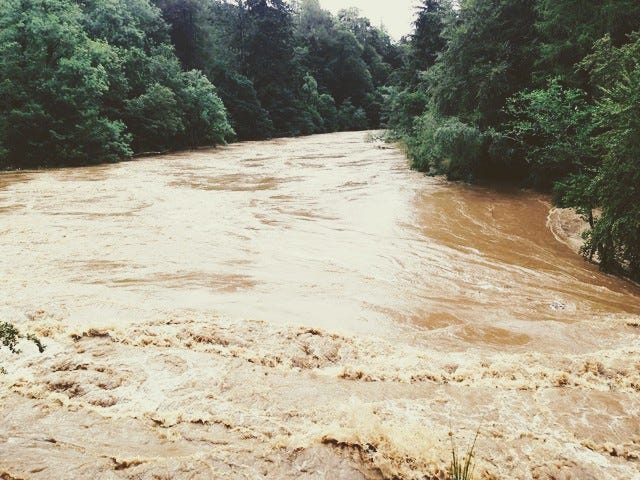
Several bloated, drowned cows floated in the brown muddy water. Esther could see them from the bridge as she passed over. She felt sorry for the animals, but not so much for Old Man Wheeler. Anyone who chose to have their pasture in a flood zone deserved for God or Mother Nature to wash their livelihood away. It was the Jackass Tax.
She pulled off onto the access road, parked, and then followed the river on foot, heading east while the cows struck out west. She hung a canvas pouch over her shoulder and replaced her sandals with rubber boots. Just off the gravel road she found a worthy walking stick.
The river flooded most springs, and Esther sometimes found some good stuff washed ashore when the waters receded. Mostly it was trash and uprooted saplings no bigger around than her leg. A lot of aluminum cans washed up; she’d made good money over the years collecting them and taking them for scrap. Once she’d found an antique sewing machine table—it had to be worth a pretty penny—but it was too heavy to drag back to the car, and she had to leave it. All her friends knew about the aluminum, but she kept the jewelry a secret. They wouldn’t believe the sheer amount of jewelry that washed ashore, some of it quite valuable.
Using the stick for balance, she eased along the bank. Last week’s floodwaters weren’t as high as they were a few days earlier; the brown sludge easing back to where it belonged. The trees were just beginning to bloom, and some of them were fat with greenery while others were still naked and emaciated. The undergrowth hadn’t come in yet, making traversal easier, but the saturated ground made for slick going. Her rubber boots made smacking sounds each time she took a step.
Ten feet from the water, the soil and vegetation created a slight plateau, and from the shelf of brown-green grass, red clay-like sand sloped gently down to the bank. Waterlogged branches and trash choked the sandy area, causing Esther to frequently maneuver back into the trees to skirt the blockages.
The day was hot with a cold wind blowing from the north, and soon her skin was slick as the bank, and the breeze chilled her as she moved across dappled shade and sun. It was too warm for a jacket and too cool to go without. She hoped to find something good, but an hour had only produced a handful of sour beer cans. They crinkled against one another in her pouch. Nothing else was worth the time to pick up and carry.
She paused and stretched her back, turning her face fully into the sun, eyes closed, skin drinking in the warm rays after months of overcast gloom. A lot of folks dreaded flood season, but it was her favorite time of the year.
A few minutes after starting back up, she came upon what looked like a drowned nest of black, slimy snakes. Their tails draped across the sand and dipped their tips into the water, and all the heads were twisted into one large knot in the middle. She’d never seen anything like it. Curious, she eased forward, keeping her walking stick planted firmly in the muck and using a low hanging branch for added stability. She lifted the back third of the nearest creature with the mud-caked stick.
Esther gasped and nearly dropped her stick and slipped and fell on her ass. They weren’t snakes. She knew what it was but didn’t believe it. The thing she held was smooth and dark on top, but the underside was bright and pale with two rows of circular protrusions running the length of the... “Tentacle,” she said in disbelief. The protrusions were suckers, and the snake was a tentacle.
She leaned forward. Half buried in the sand was the creature’s bulbous head, what she’d taken earlier to be a wad of snakes. Most of the tentacles lay in the sand, but a few disappeared into the dirty water.
She didn’t want to say what it was. Didn’t want to think it. It didn’t make any sense. The nearest coast was a six hour drive south. The river broke off from the Tennessee in north Alabama and joined the Mississippi down in the delta. This thing... octopus... would have had to swim against the current the whole way. “An octopus,” she said. She eased the words slowly out. Even though she was alone, she kept her voice down should someone overhear and demand a psych eval.
Esther lived in the area all sixty years of her life and had never seen anything like this. Alligators inhabited stretches of the river, along with snapping turtles, gar, catfish, and other fish she couldn’t name. There were counter currents that could pull an olympic swimmer into a muddy bear hug never to surface again. Now there was a dead octopus lying on the bank.
She ran a tentative finger along the skin. It was black as oil, smooth as polished stone, and cold as a fresh can of Coca-Cola. She pinched and found it fatty, rubbery.
No one would believe her, of course. Unless she took it with her. Maybe she could sell it. There were a couple taxidermists in the county that might be interested. Hell, it was so rare surely someone would pay good money for the thing.
Gripping the tentacle, she pulled, but it was slimy and heavier than she expected, and it pulled from her grip to splat back onto the sand. She swore and eased closer, leaning her walking stick against a nearby trunk so she could use both hands. She dug her fingers beneath the suckers for some texture to hold onto. With a deep breath, she heaved. She ground her teeth, blood rushed to her head, her heart pounded, and a twinge of pain started in her lower back. It moved, not much and not fast, but it did come her way.
The tentacle squirmed in her hand, and she yelped and threw it away. She stumbled back toward the trees and snatched up her stick, holding it out like a spear. Her breaths came out ragged, and the pouch’s strap felt like it would strangle her. She waited for the thing to move again. She would bash it until it was dead for real. The sunlight shining on the skin gave the impression of continual movement, of a smooth slither, but she blinked and watched and blinked, and it just lay there.
After a minute her heart and lungs calmed, and the thing still lay there, and she knew she was being silly. Her mind surely invented whatever she had felt. It was dead, all right. It had to be.
Letting the stick drop, she reached out for the tentacle.
The tentacle grabbed her instead.
As soon as her fingers touched the skin, the tentacle snapped to life and wrapped around her wrist. She screamed and pulled as hard as she could. The tentacle pulled harder. Three more squirmed to life and joined the first, forming a slimy, squirming sleeve up her arm. Her boots dug furrows in the muddy sand as it dragged her forward to the river. Most of the octopus’s body had sunk into the churning waters, and the trailing tentacles were pulling her along with it.
She screamed and screamed and jerked and fought, but it was no use.
She was exhausted by the time the water lapped at her boots. Still, it pulled, and she knew she couldn’t get free, and there was no one around to hear her screams. The river climbed up her body as she was slowly drawn within.
Turning her head, she took a last deep breath and was pulled under.
The brown much swallowed her. Quickly the water faded to black, no light penetrating the surface. Deeper still she was pulled into the belly of the river.
And then, through some form of diabolism, the scum cleared from her eyes, and the dirty water seemed as clean as a fresh artesian spring. She could see the thing to which she was pulled, the rest of the creature. The thing she took for an octopus was but a small appendage of a horror beyond comprehension. It expanded as she neared, filling the riverbed in both directions, and much further and much deeper, and the madness that devoured her mind was a blessing.
"The jackass tax" is a great line unto itself. Well done!
Nice Read. I see Jack London to build a fire in this. Unsuspecting person thinking the mundane and WHAM! Life has other plans!